Friday, February 26, 2010

New Behind the Scenes Tour

We now offer a behind the scenes guided tour at the museum in Grand Turk. The tour is available through the website at www.tcmuseum.org. The tour has been developed for people who want a more detailed and longer experience at the museum. This may be divers who are really interested in seeing collections from shipwrecks around Grand Turk that are not on display. This may also be cruise ship tours who want an experience a little more personal and less crowded.

Yesterday we had our first guests on the tour. Ken and Debby came off the Carnival Liberty.

Jessica took them through the museum and the Molasses Reef Wreck. For the "behind the scenes" portion in the labs, someone was working on the Provo Island Wise exhibit case, so they got a full discussion of how museum exhibits are developed.

They had a great time. In fact Ken said that the tour was the "highlight of their cruise."

Thursday, February 25, 2010

Renaissance Musician?

On Tuesday we had a local musician's jam at the museum. Often during these events visitors will show up and sit in. On this particular night Wally Jarvis, a Renaissance musician from Michigan, came and played a 13th century wooden flute.

The evening was incredible. The Wet Lab and outside areas were full of people. The blend of island music and Medieval flute was particularly captivating. Truly remarkable. One of the best music events we have held at the museum.
We appreciate participation like this. It not only makes the museum a fun place to come to, but it makes our programs fun for us as well.

Friday, February 19, 2010

Finished Digging!

By Rory McEathron

The surveying part of the archaeological project finished today. We covered another 15 holes (many of which we were forced to surface collect) and found a wide range of colorful ceramic fragments and broken bottles.

I learned today that it is possible to estimate the age of a bottle by measuring how deep the indentation on the bottom is. Present-day glass bottles usually have flat bottoms, but when bottles were made in the 19th century they were blown on the end of a rod. The older bottles had very large indentations on the bottom where the rod was placed.

We were also greeted today by a Yellow-Crowned Night Heron at one of our holes. These birds, which stand about two feet tall, are basically fearless and do not fly away unless closely approached. After watching the bird for nearly five minutes, it flew into the dense scrub and disappeared. I always find the incredible variety of creatures God has created amazing...I was astounded again today and I hope that I will continue to be! Artifact cleaning tomorrow!

Talking Taino Event Great Sucess

by Jessica Brody

This Friday's event with Betsy Carlson, author of Talking Taino, was a great success. Betsy signed copies of her book and she and her team of archeologists revealed the artifacts uncovered at this week's dig on GT-4, the 4th Lucayan site discovered off Cork Tree Beach, Grand Turk. We learned how the island people used small conch shells to break the foot off of larger conch shells releasing the meat. Talk about using what nature gave you!

Also on the site were bits of 1800 and 1900 pottery which may be evidence of Cork Tree Plantation. Rory told stories about how much easier it was to distinguish the familar china patterns from the tiny Lucayan beads. People were astounded by how very careful you had to be not to mistake the pre-historic artifacts with rocks!

The night wrapped up with some acoustic music accompaniment from Allesio. Thanks to all who attended and helped make the night a success!

Thursday, February 18, 2010

The Excavation: Day 4

By Rory McEathron

Our archaeological dig led us to 19th-century remnants of an old building behind Corktree Beach today. The building, which the Museum Director believes was originally known as Corktree Plantation, is today simply a pile of burned and broken rocks—however, the ruins are littered with broken ceramic fragments.

Most of the shards are blue and white, while others are various shades of red, green and brown. These fragments, which date from the mid-1800s to the early 1900s, are easy to see on the screen. When compared to the dark brown beads and bone fragments that we’ve been finding, these vivid shards seem to jump from the ground.

We also began using a laser range finder today. Instead of pacing out every distance, we simply press a button and the exact distance is projected onto the tiny screen. I always find the new technology incredible...how can a tiny device have so much processing power? I guess that’s why I’m not a computer programmer! Day five tomorrow—all the holes should be finished by the end of the day!

Wednesday, February 17, 2010

Another Day, Another...Digging?

By Rory McEathron

The archaeological excavation continued today, mindless of the overcast weather--which I thoroughly enjoyed. The whole group worked incredibly hard today, digging 22 new holes (most of which had nothing of substance in them) and covering almost two acres.


Had it been hot and sunny like yesterday, I think that we may have had casualties—I am exhausted anyway. The ground we’re covering is covered with hundreds of thorn-bushes, and I think that seeds could actually be planted in the dirt-filled gouges in my legs and arms. We’re definitely making good progress though.


Debbie and I talked for close to half an hour about Hollywood archaeology today while we were working. Why can’t real archaeology be like we see in Indiana Jones? I mean, he walks onto a site and finds the priceless treasure in his first hole! So far, out of 56 holes, the most interesting thing that we’ve found is…a tiny piece of pottery? I’m really having fun with it —it’s hard work but I’m learning a lot and getting to spend time with people I’d never have a chance to otherwise. Day four tomorrow!

Tuesday, February 16, 2010

The Excavation Continues!

By Rory McEathron

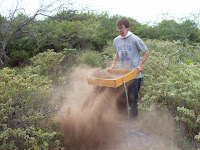
We (the Museum Director, two American professionals, and I) continued with the excavation of archaeological site GT-4 today. The project, which I code-named Operation Queen Conch, is starting to move along more rapidly. Over 30 holes have been dug and innumerable conch fragments and bone pieces discovered.


Neal and I worked together again today, which I really enjoyed. As we worked, our topics of conversation changed again and again—from TV shows to baseball (my favorite sport) to snorkeling—and I think that we both learned a lot about each other today.


At the same time, the dig became much more exciting as we began finding Lucayan artifacts. The artifacts—which range from shell beads to fish vertebrae—date to around 800 A.D. and are usually buried around 40 centimeters deep. We started using a finer screen to catch more artifacts and it quickly paid off, as we found several bead fragments and a few complete beads. It was the beginning of what would turn out to be a day of many holes and even more artifacts. I’m learning a lot and am definitely enjoying this experience!